


Learn about ONTAP Foreign LUN Import


 Suggest changes

 PDFs
PDFs
Foreign LUN Import (FLI) is an ONTAP capability that enables block level (LUN) data migration by copying user data from a foreign array LUN into an ONTAP LUN. ONTAP performs the migration by acting as a SCSI initiator that reads from the foreign LUN and writes to the destination ONTAP LUN.
FLI operates strictly at the LUN level and is intended for SAN migrations; it is not a file-level migration tool (NAS/file protocol migrations such as NFS/SMB require different approaches). FLI supports both offline and online migrations. In offline mode, host I/O is stopped for the duration of the import; in online mode, host operations resume after a short cutover while the import continues in the background.
Foreign LUNs appear in the ONTAP storage stack and must be explicitly marked as foreign to prevent accidental overwrite/ownership. FC FLI used FC backend connectivity (initiator ports, zoning/masking), while iSCSI FLI, the backend uses a iSCSI software initiator bound to intercluster connectivity, while the host-facing (frontend) protocol after migration can still be FC or iSCSI depending on design.
The following summarizes the key differences between the offline and online migration approaches.
| Area | Offline FLI | Online FLI |
|---|---|---|
Host I/O during import |
Host I/O is stopped for the full import duration. |
Host I/O can run while the import copy continues (after cutover). |
Downtime profile |
Requires downtime throughout the import window. |
Designed to be mostly non-disruptive, typically requiring only a short outage for cutover. |
Operational use case |
Best when longer downtime is acceptable or required by the application or host model. |
Best when downtime must be minimized and you can tolerate background copy activity. |
In the offline workflow, the host is disconnected for the entire duration of the import.
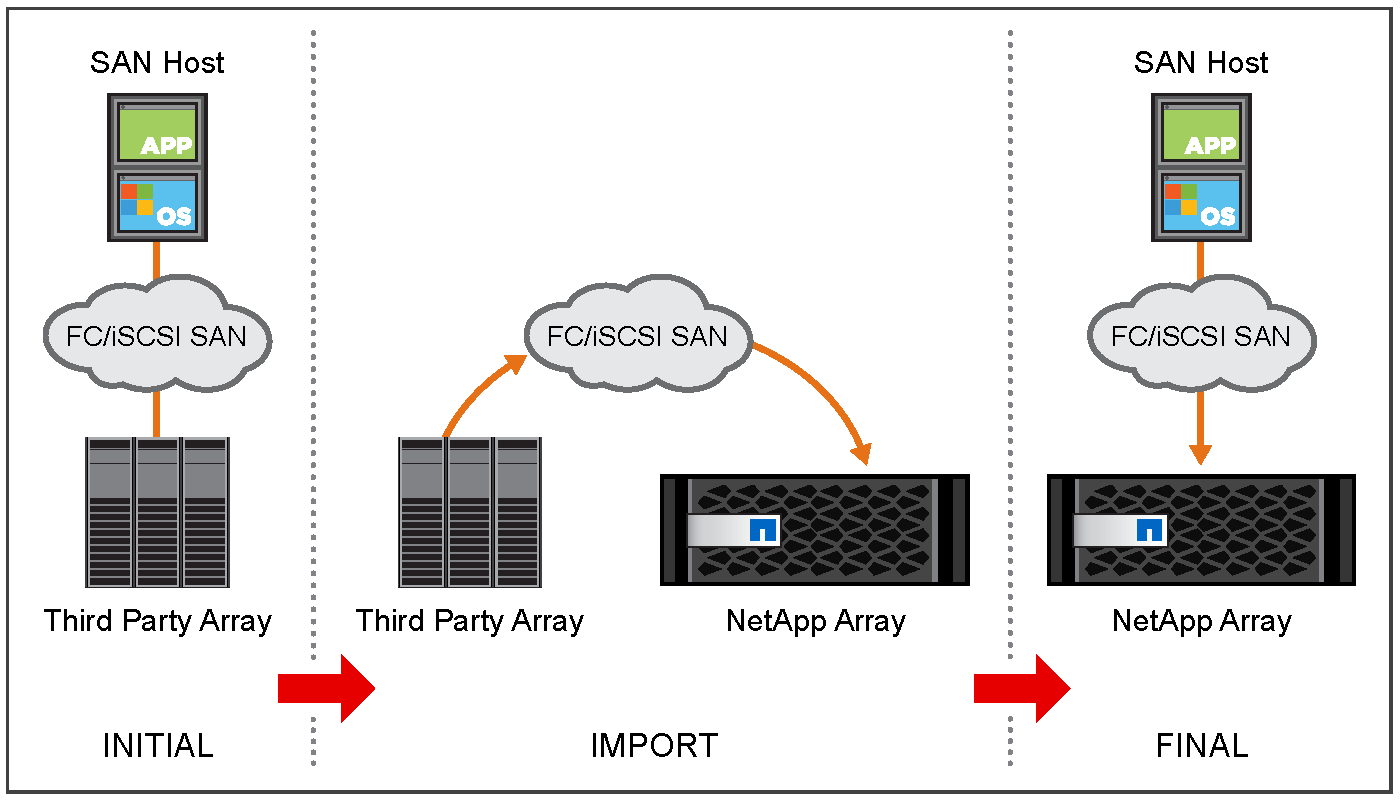
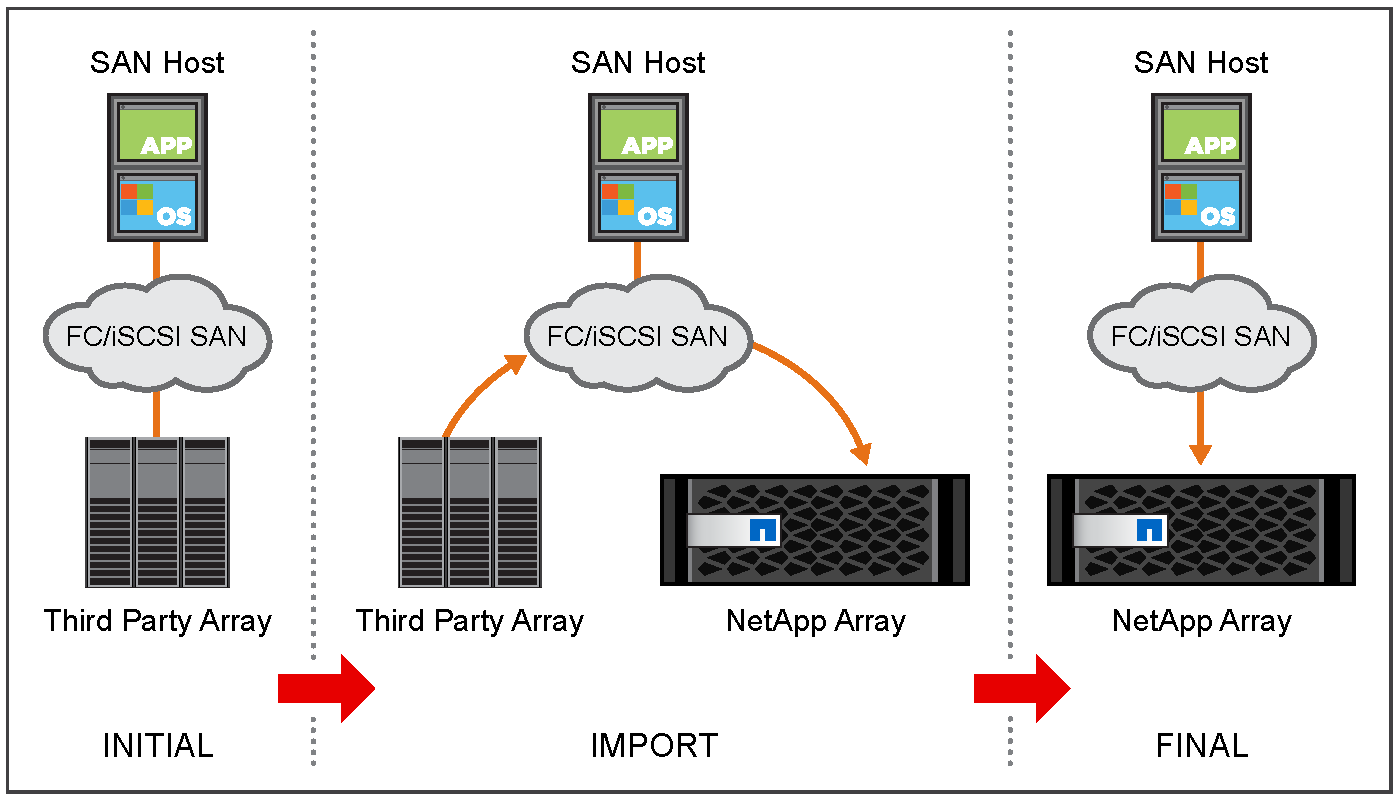
In the online workflow, the host is disconnected only for a short cutover period while the import transitions from copying to completion.
Learn about key features and benefits of ONTAP Foreign LUN Import
ONTAP Foreign LUN Import (FLI) is a built-in block migration capability that copies data from a foreign (third-party) array LUN to a native ONTAP LUN and supports both offline and online migration styles. FLI is designed to migrate SAN LUNs from a range of third party arrays into ONTAP, and it offers a consistent migration methodology that helps standardize planning, execution, and validation across different hosts and arrays.
Key features
-
Online and offline migrations to match business downtime requirements.
-
Block-level, OS-independent migration does not rely on host volume managers or OS utilities to move the data.
-
Works across heterogeneous SAN environments and is designed to migrate SAN LUNs from a range of third party arrays into ONTAP.
-
Backend transport is flexible with both FC and iSCSI backend connectivity, although supported configurations depend on interoperability validation.
-
Native multipathing and load balancing support that leverages standard SAN pathing models.
-
CLI-driven control and visibility, enabling repeatable execution and operational monitoring.
Key benefits
-
ONTAP FLI is included with ONTAP. A separate migration appliance is not required to perform FLI-based LUN imports.
-
Reduces downtime risk by enabling an online workflow where host access can resume after a short cutover while the import continues in the background.
-
Consistent migration methodology that helps standardize planning, execution, and validation across different hosts and arrays.
-
Supports complex transition scenarios, including 7 Mode to ONTAP migrations where alignment and format considerations can be addressed as part of the transition workflow.
-
Strongly supported operational model, although professional services are not mandatory, NetApp recommends professional services or qualified partners for scoping, planning, and training for anything beyond simple migrations.
Learn about the ONTAP Foreign LUN Import prerequisites
Before starting an ONTAP Foreign LUN Import (FLI), there are several prerequisites that must be in place to ensure a successful migration. These prerequisites cover compatibility, connectivity, and configuration requirements that are essential for the FLI process to function correctly.
-
Backend connectivity must be available for the chosen transport:
-
FC FLI requires at least one FC port per controller that can operate in initiator mode (two ports, one per fabric, are preferred for redundancy).
-
iSCSI FLI requires intercluster (IC) LIFs (or Ethernet ports capable of hosting IC LIFs), because the iSCSI software initiator binds outbound sessions to IC connectivity.
-
-
Foreign LUN must be discoverable in ONTAP before import. The foreign array LUN must be visible in the ONTAP storage stack (discovery is a prerequisite for import).
-
Mark the source LUN as “foreign” in ONTAP. After the foreign LUN is discovered, it must be explicitly marked foreign to prevent accidental ownership or overwrite behaviors.
-
The source LUN must be stable. The foreign LUN must not be expanding or contracting during the import workflow.
-
The foreign LUN must use 512 byte sectors (512B block size) for import compatibility, other sector sizes are not supported for import.
-
The destination ONTAP LUN must match the source LUN size. The “create LUN using foreign disk” workflow ensures the destination LUN is created to the correct size.
-
The destination ONTAP LUN must be mapped to at least one igroup based on the frontend protocol plan so the host can be attached at the correct stage of the workflow.
-
The foreign LUN and destination ONTAP LUN must be paired via an import relationship before starting the import copy.
Keep the destination ONTAP LUN offline before creating the import relationship; after the relationship is created, the LUN may be brought online only when performing online FLI so the host can resume I/O while copy continues.
Learn about ONTAP Foreign LUN Import supported configurations and platforms
ONTAP FLI must be deployed in a supported configuration to ensure predictable behavior and full supportability.
-
All FLI migrations are performed at the LUN (block) level; file and protocol-level migrations are outside of the ONTAP FLI scope.
-
Plan for up to 8 concurrent imports per node as the recommended starting point. In best-case conditions, do not exceed 16 concurrent migrations per node, and reduce concurrency if observed host latency or import latency increases.
-
Beginning with ONTAP 9.12.1, the maximum foreign LUN size for import is 125 TB per LUN. See the Knowledge Base article Unable to migrate Array LUN greater than 16 TB using FLI for more details.
-
iSCSI session scaling limits (backend iSCSI):
-
1 initiator per IC LIF
-
Up to 16 sessions per LIF
-
Up to 32 sessions per node
-
-
iSCSI protocol constraints:
-
No iSCSI discovery sessions
-
No multi connection sessions (MCS)
-
Error Recovery Level > 0 is not supported (ERL0 only)
-
IPv6 is not supported for iSCSI initiator LIF usage
-
-
Security and management availability notes:
-
CHAP is not included
-
REST API coverage for iSCSI FLI operations is not available (CLI workflow only).
-
-
Operational planning note for online imports:
-
In online FLI, the host I/O and import copy share backend resources
-
Imports may be paused and resumed to protect host latency
-
Migrations should be scheduled during non-peak windows if possible
-
Supported configurations and platform
As new configurations are qualified over time, supported combinations can change. For each migration, validate the end to end stack (source array + host + fabric/network + ONTAP target) against the current interoperability guidance.
-
ONTAP is the only supported destination for FLI migrations. FLI is designed to import data into ONTAP LUNs; migrations to third party destination storage are not supported.
-
For iSCSI FLI, the iSCSI software initiator is integrated with the FLI stack and is intended specifically to enable foreign LUN discovery and import using iSCSI/TCP backend connectivity.
Platform coverage depends on the backend transport used for discovery/import:
-
FC backend FLI (traditional) supports ONTAP on AFF / ASA / ASA r2 / FAS (per the comparison table in the iSCSI test design).
-
iSCSI backend FLI expands coverage to include AFF / ASA / ASA r2 / FAS / ONTAP Select / Cloud Volumes ONTAP (CVO) (per the same comparison).
-
With FC backend FLI, supported foreign arrays are typically validated through established interoperability listings and qualification guidance (the supported list evolves as new arrays are qualified).
-
With iSCSI backend FLI, no foreign arrays are pre-qualified by default; customers are expected to perform field qualification using the provided qualification tools (for example, sanlunmigrate / offtap sanlunmigrate) before committing to a production migration.
-
Host OS support should align with the SAN host interoperability guidance for the chosen front end protocol (FC or iSCSI) and the post migration host configuration.
-
Switch/fabric support must also be validated as part of the end to end configuration (especially for FC environments where zoning/masking is required).
After the import is complete and hosts are running on ONTAP LUNs, ensure that the final steady state configuration is supported. This includes host multipathing, HBA/driver/firmware levels, zoning/masking (FC), iSCSI configuration (if used), and any ONTAP feature interactions you plan to use.
-
iSCSI FLI uses intercluster (IC) LIFs for backend iSCSI sessions. Creating new IC LIFs on a different subnet solely to reach foreign targets when existing IC LIFs are already established on another subnet is treated as unsupported planning guidance.
-
The iSCSI initiator session configuration is intended to exist only for the migration and should be cleaned up after migration completion to avoid operational side effects, including upgrade and revert considerations.
Best practices
NetApp strongly recommends a professional services or partner professional services, engagement to scope and plan the migration as well as to train customer personnel on how to perform data migrations using Foreign LUN Import (FLI) 7-Mode to ONTAP.
-
Perform one or more test migrations at least a week prior to your migration project to verify configuration, connectivity, and throughput; uncover any other issues; and validate your methodology.
-
For maximum throughput, don't run more than 16 migrations concurrently per node.
-
Verification is not required, but we encourage you to verify a subset of the LUNs imported and migrated to validate the import process.
-
Use the throughput observed in your test migrations to plan production migration