


NetApp AFX overview: Learn about NetApp AFX


 Suggest changes

 PDFs
PDFs
NetApp AFX is still ONTAP — it's simply a different way to leverage the benefits of ONTAP. NetApp AFX delivers disaggregated architecture for NAS and object workloads while still providing the feature-rich ONTAP software you know and love.
An Evolution of Innovation: NetApp ONTAP
NetApp ONTAP was created in 1992 as a new way to serve NFS workloads to multiple clients, while revolutionizing performance, data resiliency, point in time copies, and more. It originally only supported NFSv2, but as demand grew for newer NFS versions, other data protocols, more data protection features, NetApp ONTAP had to evolve.
Below is an abbreviated timeline of some of the major ONTAP evolutions that have taken place over the past 30+ years.
The evolution of NetApp ONTAP
| Decade | Features |
|---|---|
1990s |
NFSv2, NFSv3, CIFS, Snapshots, WAFL filesystem, AutoSupport, SnapMirror |
2000s |
SnapVault, SnapLock, NFSv4, Block protocols, FlexVols, FlexClone, GX/Scale out, Deduplication, file clones |
2010s |
Clustered ONTAP, inline storage efficiencies, NFSv4.1/pNFS, NVMe, RAID-TEC, FlexGroup volumes, volume encryption, AFF, Cloud Volumes ONTAP, QoS, FabricPool, Azure NetApp Files (ANF), Google Cloud NetApp Volumes (GCNV), All SAN Array (ASA) |
2020s |
SnapMirror Business Continuity, FlexCache, ONTAP S3, IPsec, Autonomous Ransomware Protection, SnapMirror in and out of ANF and GCNV, Amazon FSxN, ASAr2, NetApp AFX you are here |
NetApp ONTAP personalities
For years, ONTAP ran as a single unified platform, combining file, block, and object into a single system. This positioned ONTAP as the Swiss army knife of the datacenter – a platform that could do anything you asked it to.
However, as applications evolved and datacenter requirements changed with a series of shifts in the IT industry, demand for platforms that could do specific things grew. As a result, there are now a few different ways to consume ONTAP.
NetApp ONTAP personalities
| ONTAP Personality | Description |
|---|---|
Unified ONTAP |
Same ONTAP you have always known, still being actively developed and improved. |
All SAN Arrays |
ONTAP that supports only iSCSI, FCP and NVMe over FC/TCP and provides active/active controller functionality, as well as disaggregated concepts in ASAr2. |
Cloud-resident ONTAP |
ONTAP that runs in the cloud; either on bare metal systems sitting in a cloud datacenter or virtualized ONTAP instances. |
Disaggregated ONTAP/AFX |
ONTAP using disaggregated architecture for high performance NAS and object workloads. |
Unified ONTAP architecture overview
The following diagram shows the general architecture of unified ONTAP, with a description of how it all fits together below it.
General ONTAP architecture
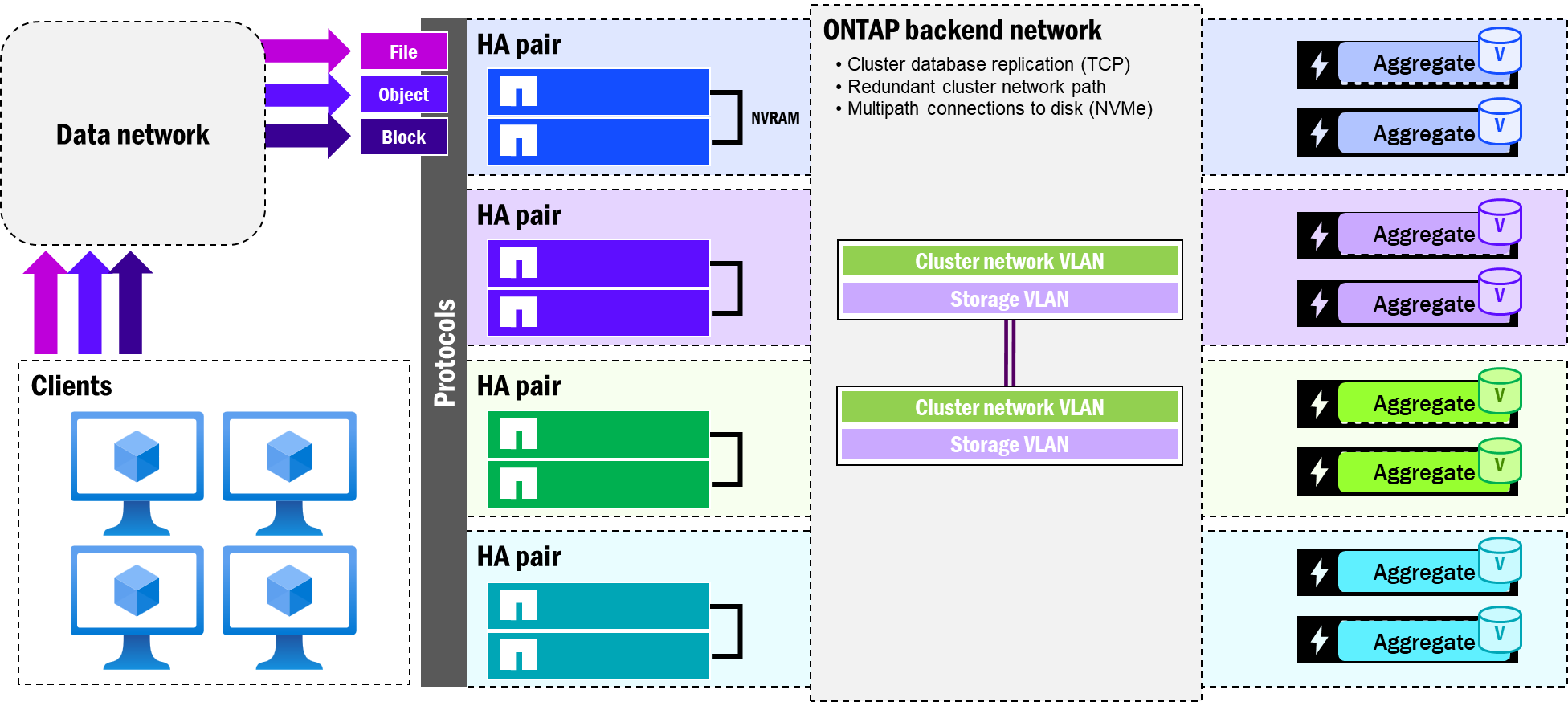
Some key aspects of the ONTAP architecture:
-
File, object, and block support
-
Protocols are served via a front-end client data network
-
Multiple independent nodes can be clustered together
-
Each node can provide independent floating IP addresses for data and management use cases
-
Clustered nodes connect to a NetApp-provided backend switch over a cluster VLAN
-
Nodes are presented as HA pairs to provide resiliency in case of hardware or power outages
-
HA pairs have directly connected NVRAM cards that replicate to protect writes
-
Each node is assigned at least one aggregate and owns a subset of the total number of disks
-
In failovers, a node's disks get reassigned to the HA partner (and only the HA partner)
-
Disk shelves are usually directly attached to nodes via multipath cabling, but higher end systems introduce the concept of storage networks on the same backend cluster switch
-
Volumes (FlexVols and FlexGroup volumes) provide the entry points to the storage for data access
What is NetApp AFX?
One thing to keep in mind here is that NetApp AFX is still ONTAP.
It's simply a different way to leverage the benefits of ONTAP. The same image you would install for your Unified ONTAP or All SAN Array systems is the same image used with NetApp AFX. The codebase is identical, but the way the systems boot up determines what code path is followed, how the backend storage is presented, and what features and protocols are supported.
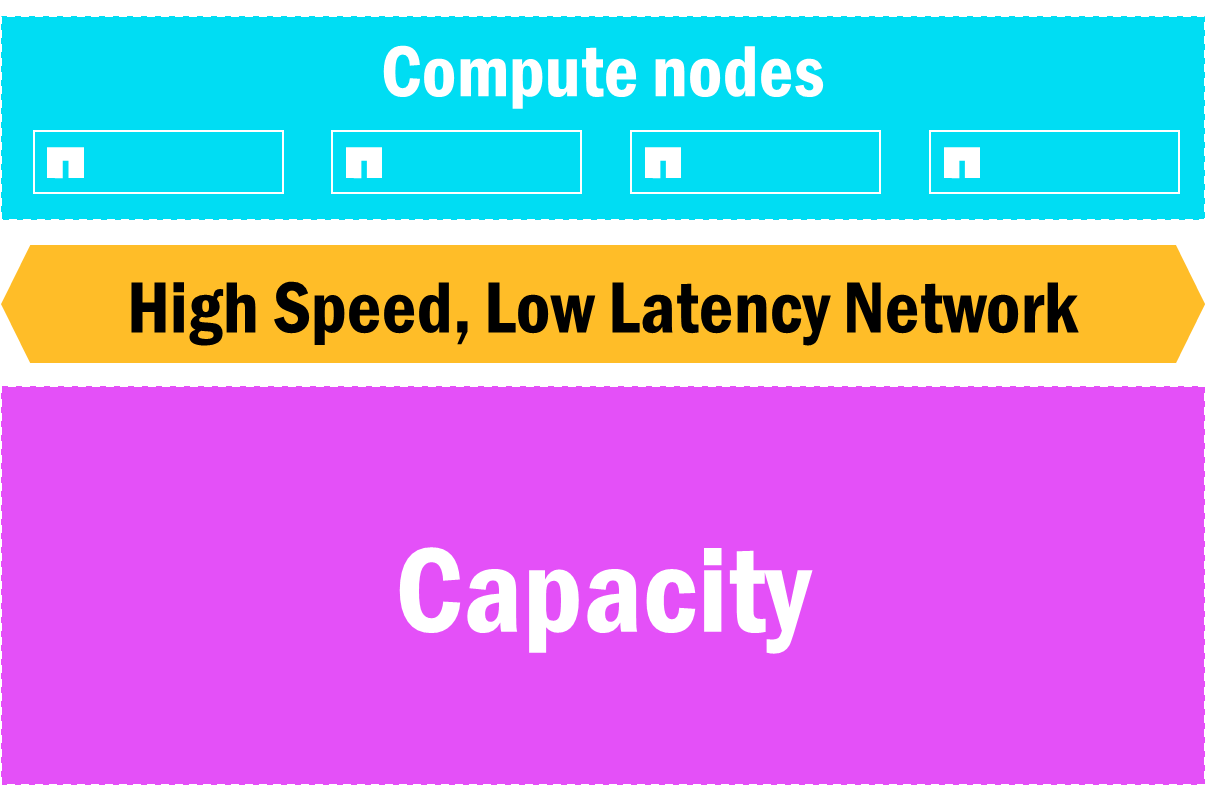
NetApp AFX delivers disaggregated architecture for NAS and object workloads while still providing the feature-rich ONTAP software you know and love. Disaggregated ONTAP refers to a storage architecture where every NetApp controller node sees the same capacity by way of redundant network switches and a high speed, low latency network. This approach allows the controller nodes and storage capacity to scale independently of each other to more closely meet the needs of various high-performance workloads. In other words, when you need additional performance, simply add controller nodes. If you need additional capacity, add shelf enclosures. This gives storage administrators the flexibility to present a more cost-effective storage solution to their end users.
Because no controller node independently owns disks, there are also no physical aggregates with their own capacity and performance constraints. Instead, the capacity is presented as a shared model that all nodes can interact with, and ONTAP can automatically manage.
Disaggregated ONTAP
Key terms and concepts
Below are terms directly related to AFX. For ONTAP-specific terminology, see the product documentation.
Disaggregated ONTAP
Refers to the new architecture powered by ONTAP that offers the ability to scale compute and capacity independently of one another. The term "Disaggregated ONTAP" is not a product name but a means to differentiate between unified ONTAP and NetApp AFX architectures.
NetApp AFX
NetApp AFX is the official product name for the disaggregated ONTAP architecture and was announced at NetApp Insight 2025.
Compute nodes
A compute node in NetApp AFX refers to the storage controller node (and is often used interchangeably in docs). These nodes have no on-board disk and are intended to be fully modular to enable the independent scale that disaggregated ONTAP architecture provides.
Storage Availability Zone
A Storage Availability Zone (SAZ) is the single pool of capacity in a NetApp AFX cluster, where all disks are shared across all nodes. The SAZ enables functionality such as shared capacity, enhanced performance, global deduplication, and more.