


Learn to set up FC or FC-NVME fabrics and direct-attach configurations with ONTAP systems


 Suggest changes

 PDFs
PDFs
For FC and FC/NVMe the network topology between the storage solution and the hosts is referred to as a fabric. To create redundancy, which protects you against loss of data access, it is recommended that you set up your SAN with HA pairs using two or more switches in a multi-fabric configuration. Single fabric configurations, which use only one switch between the hosts and storage, are not fully redundant.
Beginning with ONTAP 9.19.1, you can also directly attach FC or FC-NVMe SAN hosts to HA pairs without using a switch. Direct-attachment configurations can be especially valuable in remote sites and hybrid environments where simplicity is key.
Cascade, partial mesh, full mesh, core-edge, and director fabrics are all industry-standard methods of connecting FC switches to a fabric, and all are supported. The use of heterogeneous FC switch fabrics is not supported, except in the case of embedded blade switches. Specific exceptions are listed on the Interoperability Matrix Tool. A fabric can consist of one or multiple switches, and the storage controllers can be connected to multiple switches.
Multiple hosts, using different operating systems, such as Windows, Linux, or UNIX, can access the storage controllers at the same time. Hosts require that a supported multipathing solution be installed and configured. Supported operating systems and multipathing solutions can be verified on the Interoperability Matrix Tool.
Multifabric FC and FC-NVMe configurations
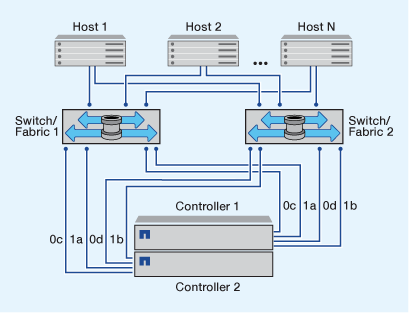
It is recommended that you configure your FC and FC-NVMe SAN hosts using HA pairs and a minimum of two switches. [EH5.1][FD5.2][EH5.3]This provides redundancy at the fabric and storage system layers to support fault tolerance and nondisruptive operations.
In a multifabric HA pair configuration, two or more switches connect the HA pair to one or more hosts. Each switch creates a separate fabric consisting of the paths between the hosts and the HA pair that pass through the switch. Adding a switch creates an additional fabric. A multifabric configuration can include two or more switches and their corresponding fabrics. For simplicity, the following figure shows only two switches, which represent two separate fabrics.
The FC target port numbers (0c, 0d, 1a, 1b) in the illustrations are examples. The actual port numbers vary depending on the model of your storage node and whether you are using expansion adapters.
Single-fabric FC and FC-NVMe configurations
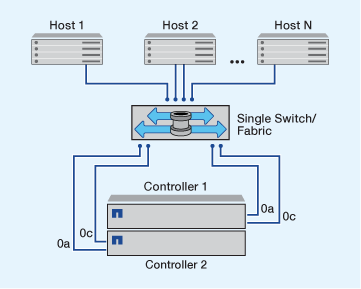
In single-fabric HA pair configurations, one switch connects the HA pair to one or more hosts. The single switch creates a single fabric consisting of all the paths between the hosts and the HA pair. Because there is no redundancy, a switch failure can cause service disruption.
The FC target port numbers (0a, 0c) in the illustrations are examples. The actual port numbers vary depending on the model of your storage node and whether you are using expansion adapters.
All platforms that support FC configurations support single-fabric HA pair configurations.
Direct-attach FC and FC-NVMe configurations
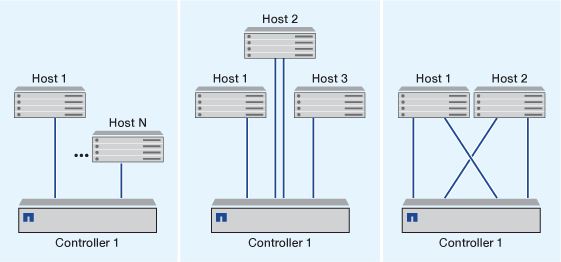
Beginning with ONTAP 9.19.1, direct-attachment FC and FC-NVMe configurations are supported for certain AFF, ASA r2 and FAS systems using the required QLogic or Emulex FC adapter card. In a direct-attachment configuration, one or more hosts are directly connected to your HA pairs without the presence of a switch. This configuration can be especially valuable in remote sites and hybrid environments where simplicity is key.

|
|
For a complete list of supported platforms and adapter cards, see the NetApp Hardware Universe.
-
Configure ONTAP FC ports for direct-attach to FC and FC-NVMe hosts.
-
Learn how Selective LUN mapping (SLM) limits the paths that are used to access the LUNs owned by an HA pair.
-
Learn about SAN LIFs.