


Cluster scale

 Suggest changes

 PDFs
PDFs
The NetApp AFX architecture simplifies node additions and removals and enables larger cluster scale without stranding capacity or performance.
Node additions and removals
Both unified ONTAP and NetApp AFX allow for nodes to be added and removed from the cluster. However, due to some of the architectural differences, the process for node additions and removals differ a bit.
Node addition/removal in unified ONTAP
We've already learned that unified ONTAP has a direct node to disk ownership and that all nodes must have some disks and at least one aggregate attached to them. With that in mind, the following holds true for additions and removals.
-
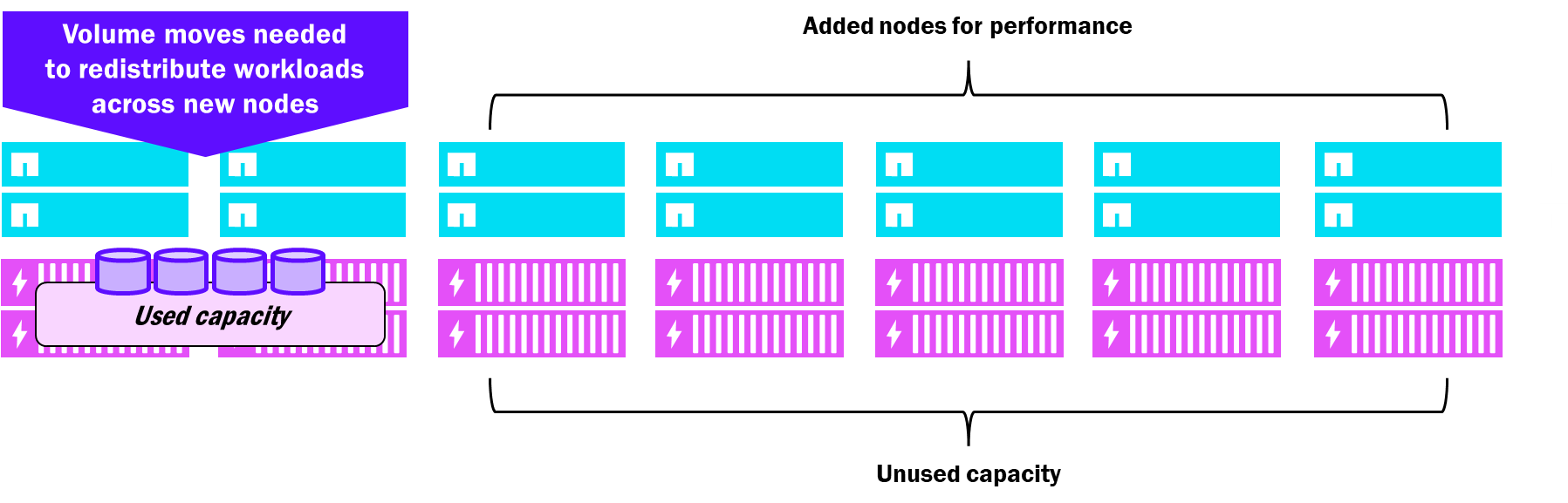
Node additions in unified ONTAP don't require any extra steps, but to provide balanced performance across all nodes (including the new nodes), volumes would need to be moved to the new nodes. This requires upfront analysis of the existing volumes and their workloads, decisions about which volumes to move, and then the actual volume moves taking place, which, again, would require a copy of that data across the backend cluster network.
-
Node removals in unified ONTAP would require a manual evacuation of existing volumes on the node, which means you must identify which nodes can host which volumes to maintain even performance, and you must have enough free capacity to provide a place for those volumes to move. If free capacity is a challenge, additional volume moves may be needed to shuffle workloads around a bit in the cluster. Node removals also HA pair removals, so the work involved is doubled. Because nodes own disks, an entire disk reinitialization would also be required for those nodes. Each of these things add time and effort to what should be a relatively simple task.
Node addition/removal in NetApp AFX
We've also learned that NetApp AFX doesn't leverage the standard node to disk ownership and does not use physical aggregates to present capacity to the cluster. Because of that, node additions and removals behave a bit differently.
-
Node additions in NetApp AFX will not require the same up-front volume analysis, nor will it require administrative intervention to ensure that each node has an even balance of volumes. Instead, ONTAP automatically balances volume counts across newly added nodes to maintain relatively even performance profiles. ONTAP automatically will move volumes across nodes without copying anything, reducing the time, capacity, and effort required for adding nodes to a cluster.
-
Node removals in NetApp AFX also don't require much – if any – manual intervention. When a node is tagged for removal, ONTAP automatically moves volumes across nodes (again, without copying) to evacuate the nodes being removed. And because there are no disks owned by the nodes, there is no need to reinitialize disks after removing nodes. This makes nodes in AFX modular in nature and easy to scale up or down.
Cluster scale and expansion
Unified ONTAP clusters support up to 24 nodes and each node that is added must also be added with disks (both for system functionality and data services). Disk shelves can be added to the cluster, but they are always connected to a single HA pair and owned only by a single node, even if the cluster is 24 nodes in size. This means that capacity is added to a cluster even when only performance is required, and that performance increase is mostly relegated to a specific set of disks owned by the new nodes. As a result, you may end up with extra capacity that you don't necessarily need.
Unified ONTAP – added scale considerations
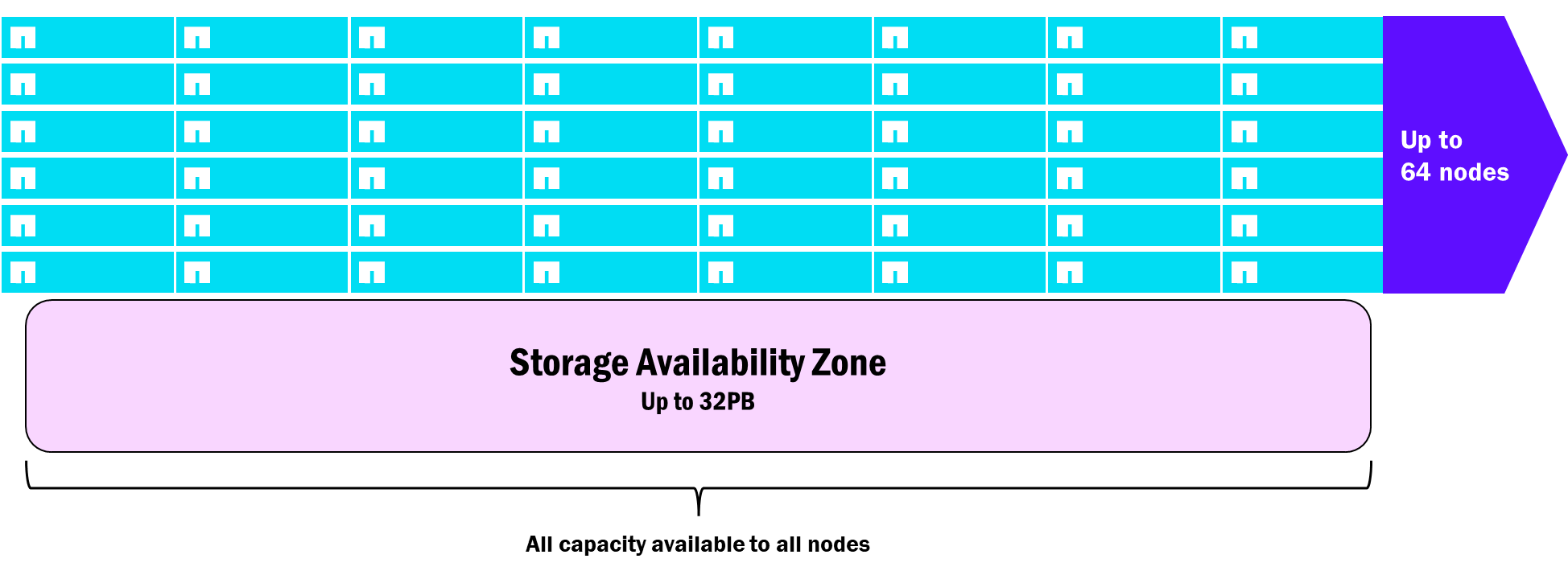
NetApp AFX supports larger scale for clusters. Starting in 9.19.1, AFX clusters can reach 32 nodes in a single cluster. And because all nodes can see and access all disks, they can all share the performance and capacity (up to 32PB as of ONTAP 9.19.1) of those drives so that there is never any stranded resource. Volume moves don't require copies, so ONTAP is able to automatically move volumes to newly added nodes to ensure evenly distributed node utilization, while capacity is evenly distributed via the Storage Availability Zone.
NetApp AFX – added scale considerations
For maximum cluster size information, see the Limits page.