


Directory indexing in ONTAP

 Suggest changes

 PDFs
PDFs
ONTAP automatically indexes large directories so targeted lookups do not have to read the entire directory file at once. Indexing is separate from maxdir-size and does not change the maximum directory-file cap.
Why directory indexing exists
An index in computing is a side structure whose job is to answer "where is this?" without walking every record. A book index is the familiar version: you look up a term and jump to a page instead of reading the whole book. Databases, search engines, and filesystems use the same idea so a lookup stays cheap as the collection grows. The index is not a second copy of the data. It is a map from a key, such as a name, to the location of that item.
A directory is a list of names. Without an index, finding one name can mean scanning a large part of that list. ONTAP's directory index is the filesystem version of that shortcut.
Without a persistent index, finding a name can require reading many directory blocks and building an in-memory hash. Beginning with ONTAP 9.2, ONTAP automatically creates a companion directory-index inode when a directory file grows to approximately 2 MiB.
The persistent index maps to the location of entries in the directory file. A targeted lookup can therefore read the required index and specific directory blocks instead of loading the entire directory file into memory. Indexing generally reduces CPU, memory, and I/O for lookup-oriented operations on large directories, which can free up more node resources for other workloads in addition to the large directory's contents.
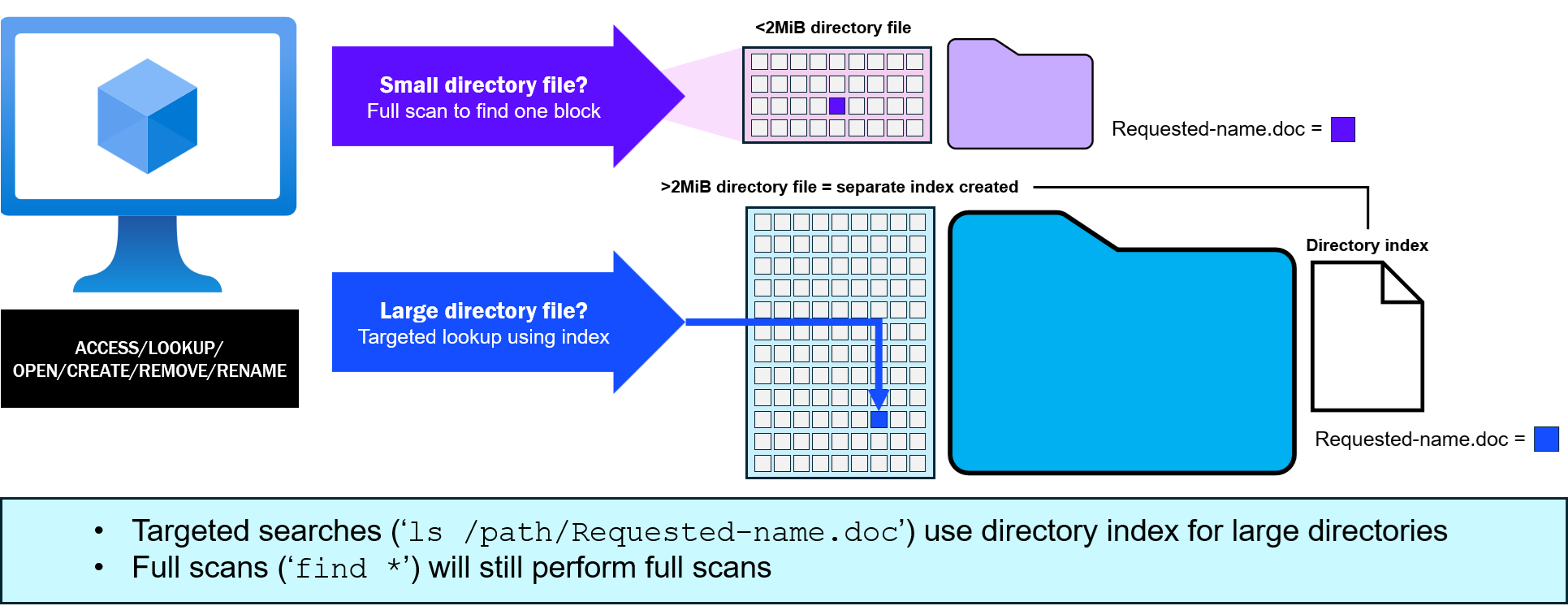
There is no administrator option needed to enable directory indexing; it is enabled by default. A directory becomes eligible for a persistent index only after its directory file exceeds the approximately 2 MiB threshold. After that condition is met, index construction can be initiated by the operation that grows the directory beyond the threshold, an indexing scanner, or a qualifying front-end name operation such as LOOKUP, ACCESS, a path-based open or create, rename, or remove. These scanner and front-end triggers do not override the size threshold or create persistent indexes for smaller directories. The approximately 2 MiB point changes how targeted lookups are served. It is not a directory-size latency threshold. How growing directories show up in client and node behavior is described in Performance impact.
What indexing does not change
The directory index is separate from the directory file. The following still holds true despite the presence of a directory index:
-
maxdir-sizestill limits the directory file size. -
The companion index consumes additional metadata and an inode but does not impact directory size.
-
Indexing improves targeted lookup as opposed to full directory enumeration.
-
Wildcard scans and
READDIRstill process the entire directory namespace. -
Losing or rebuilding the index does not remove the directory's names; ONTAP can reconstruct it from the directory file.
About private and public index inodes
Each indexed directory has its own index; directory indexes are not shared. A volume can therefore hold one index for every directory that grows beyond the approximately 2 MiB threshold. Directories below the threshold remain on the nonpersistent lookup path and do not receive a companion directory-index inode, even when scanner or front-end operations access them. Whether indexes for eligible directories count against maxfiles depends on whether they are private or public, as described here.
By default, directory indexes historically reside in the private inode space. Private directory-index inodes are omitted from SnapMirror transfers, so ONTAP rebuilds indexes at the destination on demand after activation or restore.
Beginning with ONTAP 9.17.1, the volume-level option -is-dir-index-transfer-enabled true moves directory indexes into public inode space so supported SnapMirror and SnapMirror Cloud workflows can transfer them. When the option is true, new indexes are created in public inode space and a scanner migrates existing private indexes. This can reduce post-restore index construction, but public indexes consume public inodes and must be included in maxfiles planning.
You can see if there is a public directory index with the volume show option -has-dir-index-public true. This option is not able to be manually set; it only shows true if there is a public directory index.
Public directory indexes count toward files and can increase files-used by approximately one inode for each indexed directory.
Private indexes do not consume the public files allowance.
When to enable public directory index transfers
Enabling index transfers preserves indexes for replication or restores to avoid expensive rebuilds for high-file-count directories. When index transfer is disabled, SnapMirror omits private indexes. After activation or restore, ONTAP can rebuild missing indexes for eligible directories through an indexing scanner or qualifying front-end operation, which can cause a performance impact after failing over to a SnapMirror destination. Enabling index transfers does not improve local lookup performance; local indexing already occurs when the option is false. It is strictly intended for use with volumes that are a part of a SnapMirror relationship.
Sparse directories and hole punching
A directory file can grow large and then become sparse after many names are deleted (ie when files are removed from the directory). The directory-file size will remain at its high-water mark, so a READDIR could spend substantial CPU and I/O traversing empty blocks.
For indexed directories, ONTAP can punch a hole when a 4 KiB directory block becomes completely empty.
The index tracks the hole so that:
-
READDIRcan skip the empty block. -
The physical block can be reclaimed.
-
A create can later reuse that logical location.
The advanced -has-optimized-sparse-directories field is a read-only volume show option. A value of true means that the volume contains directory blocks in this optimized, hole-punched form.
If an application's directory size remains problematic after deletion, copying the remaining entries into a newly created directory produces a more compact directory-file layout. Lowering maxdir-size does not compact a sparse directory.