


Data protection using Trident Protect


 Suggest changes

 PDFs
PDFs
This page shows the data protection options for Red Hat OpenShift Container based applications running on VMware vSphere using Trident Protect.
As users take their journey of modernizing their applications with Red Hat OpenShift, a data protection strategy should be in place to protect them from accidental deletion or any other human errors. Often a protection strategy is also required for regulatory or compliance purposes to protect their data from a disaster.
The requirements of data protection varies from reverting back to a point in time copy to automatically failing over to a different fault domain without any human intervention. Many customers pick ONTAP as their preferred storage platform for their Kubernetes applications because of its rich features like multitenancy, multi-protocol, high performance and capacity offerings, replication and caching for multi-site locations, security and flexibility.
For details about protecting and migrating container workloads using Trident Protect, review the following section:
- Protect and migrate Container apps using Trident Protect
Business Continuity with MetroCluster
Most of our hardware platform for ONTAP has high availability features to protect from device failures avoiding the need to perform diaster recovery. But to protect from fire or any other disaster and to continue the business with zero RPO and low RTO, often a MetroCluster solution is used.
Customers who currently have an ONTAP system can extend to MetroCluster by adding supported ONTAP systems within the distance limitations for providing zone level disaster recovery.
Trident, the CSI (Container Storage Interface) supports NetApp ONTAP including MetroCluster configuration as well as other options like Cloud Volumes ONTAP, Azure NetApp Files, AWS FSx ONTAP, etc. Trident provides five storage driver options for ONTAP and all are supported for MetroCluster configuration. Refer here for additional details about ONTAP storage drivers supported by Trident.
The MetroCluster solution requires layer 2 network extension or capability to access the same network address from both fault domains. Once MetroCluster configuration is in place, the solution is transparent to application owners as all the volumes in the MetroCluster svm are protected and get the benefits of SyncMirror (zero RPO).
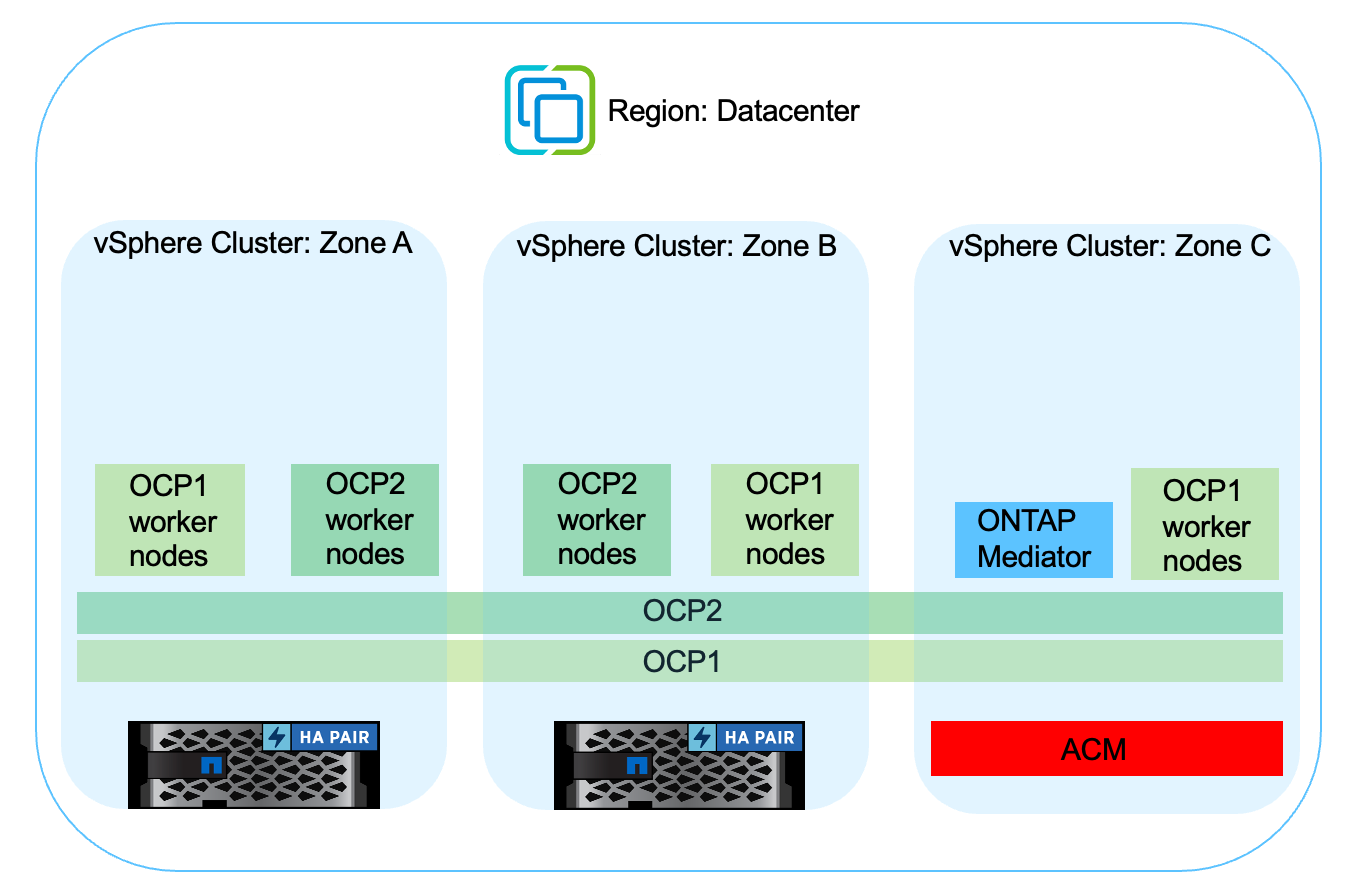

|
For Trident Backend Configuration (TBC), do not specify the dataLIF and SVM when using MetroCluster configuration. Specify SVM management IP for managementLIF and use vsadmin role credentials. |
Details on Trident Protect Data Protection features are available here.