


Fail back to the source site with NetApp Disaster Recovery


 Suggest changes

 PDFs

After the disaster is resolved, fail back from the disaster recovery site to the source site to resume normal operations. You can choose the snapshot to use for recovery.
Required NetApp Console role
The Super admin, Disaster recovery admin, or Disaster recovery failover admin role is required to perform this task. Learn about user roles and permissions in NetApp Disaster Recovery. Learn about NetApp Console access roles for all services.
About failback
In failback, NetApp Disaster Recovery replicates (resyncs) any changes back to the original source workloads before reversing the replication direction. This process starts after a relationship has failed over to the target and involves the following steps. Kubernetes workloads follow the same sequence as VMware workloads; the VMware-specific details are noted in parentheses.
-
Perform a compliance check on the recovered site.
-
Refresh the discovery information for each vCenter cluster or Kubernetes cluster identified as located in the recovered site.
-
On the target site, stop the protected workloads (for VMware, power off and unregister the virtual machines), and unmount volumes.
-
Break the SnapMirror relationship on the original source to make it read/write.
-
Resynchronize the SnapMirror relationship to reverse the replication.
-
Start the protected workloads on the source (for VMware, power on and register the source virtual machines), and mount the volumes on the source.
Before you begin
For VMware workloads, if you're using datastore-based protection, VMs might be added to the datastore during failover. If this has happened, ensure you provide the additional mapping information for these VMs before initiating failback. To edit the resource mapping, see Manage replication plans.
Steps
-
From the Disaster Recovery menu, select Replication plans.
-
In the dropdown menu, set the filter to VMware.

-
Identify the replication plan that you want to fail back. Select the Actions option
 , hover over Recover then select Failback.
-
Choose the snapshot for the datastore from which to recover. Select Take snapshot now to initiate a new snapshot or Select to choose from available snapshots.

If you're using tamperproof SnapLock snapshots, you must use the Take snapshot now option. Otherwise the operation will fail. 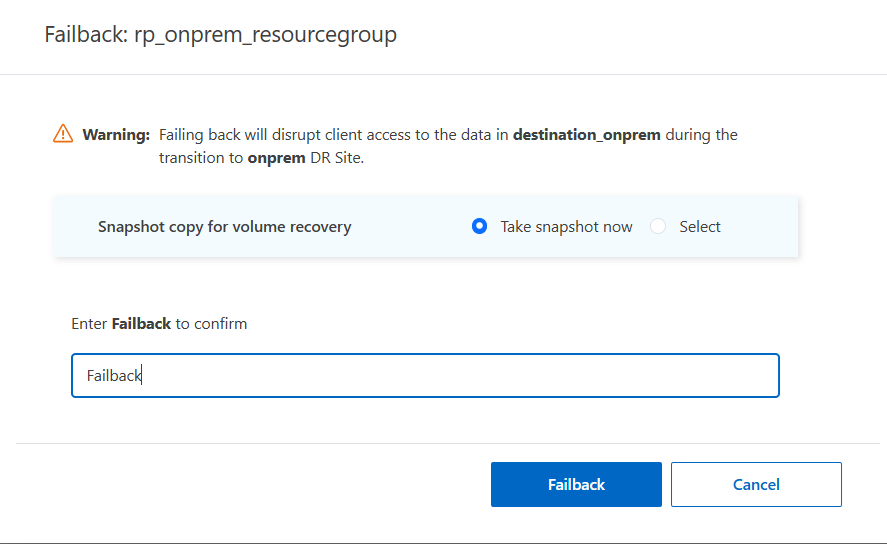
-
Enter "Failback" to confirm the operation then select Failback.
To monitor the job's progress, select Job monitoring in the Disaster Recovery menu.
-
From the Disaster Recovery menu, select Replication plans.
-
In the dropdown menu, filter to Kubernetes replication plans.
-
Identify the replication plan that you want to fail back. Select the Actions option
, hover over Recover then select Failback. -
Choose the snapshot for the cluster from which to recover. Select Take snapshot now to initiate a new snapshot or Use latest snapshot to use the most recent, successful snapshot.
-
Enter "Failback" to confirm the operation then select Failback.
To monitor the job's progress, select Job monitoring in the Disaster Recovery menu.