


Learn about ONTAP path failover management


 Suggest changes

 PDFs
PDFs
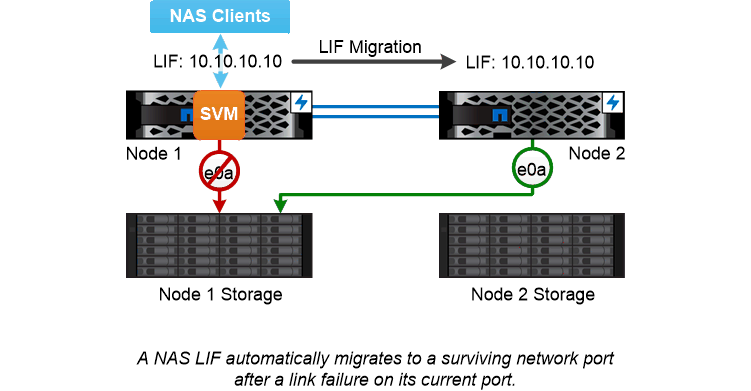
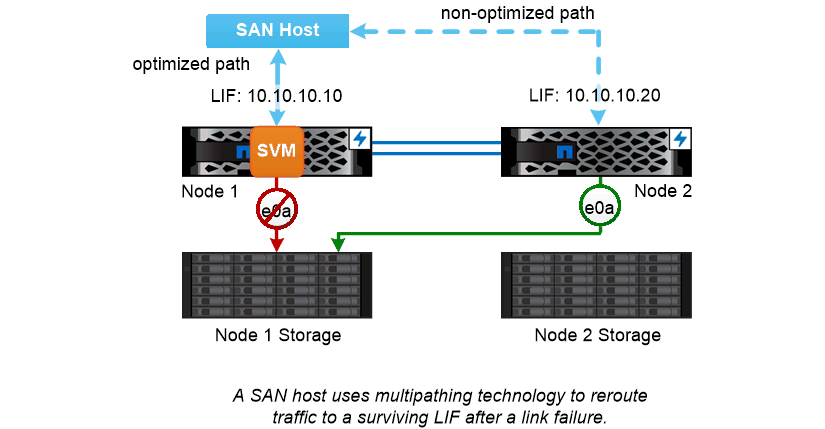
There are important differences in how ONTAP manages path failover in NAS and SAN topologies. A NAS LIF automatically migrates to a different network port after a link failure. A SAN LIF does not migrate (unless you move it manually after the failure). Instead, multipathing technology on the host diverts traffic to a different LIF—on the same SVM, but accessing a different network port.
NAS path failover
A NAS LIF automatically migrates to a surviving network port after a link failure on its current port. The port to which the LIF migrates must be a member of the failover group for the LIF. The failover group policy narrows the failover targets for a data LIF to ports on the node that owns the data and its HA partner.
Beginning with ONTAP 9.19.1, the ONTAP system-defined failover group policy dynamically expands the failover targets for NAS data LIFs to potentially include any available ports in the broadcast domain on any available node in the cluster. You can apply the system-defined policy to any failover group. Prior to ONTAP 9.19.1, LIFs with this policy could fail over to only one other node in the cluster; if that node was out of quorum, the LIF would not failover, even if there were other nodes available.
For administrative convenience, ONTAP creates a failover group for each broadcast domain in the network architecture. Broadcast domains group ports that belong to the same layer 2 network. If you are using VLANs, for example, to segregate traffic by department (Engineering, Marketing, Finance, and so on), each VLAN defines a separate broadcast domain. The failover group associated with the broadcast domain is automatically updated each time you add or remove a broadcast domain port.
It is almost always a good idea to use a broadcast domain to define a failover group to ensure that the failover group remains current. Occasionally, however, you may want to define a failover group that isn't associated with a broadcast domain. For example, you may want LIFs to fail over only to ports in a subset of the ports defined in the broadcast domain.
Subnets A subnet reserves a block of IP addresses in a broadcast domain. These addresses belong to the same layer 3 network and are allocated to ports in the broadcast domain when you create a LIF. It is usually easier and less error-prone to specify a subnet name when you define a LIF address than it is to specify an IP address and network mask. |
SAN path failover
A SAN host uses ALUA (Asymmetric Logical Unit Access) and MPIO (multipath I/O) to reroute traffic to a surviving LIF after a link failure. Predefined paths determine the possible routes to the LUN served by the SVM.
In a SAN environment, hosts are regarded as initiators of requests to LUN targets. MPIO enables multiple paths from initiators to targets. ALUA identifies the most direct paths, called optimized paths.
You typically configure multiple optimized paths to LIFs on the LUN's owning node, and multiple non-optimized paths to LIFs on its HA partner. If one port fails on the owning node, the host routes traffic to the surviving ports. If all the ports fail, the host routes traffic over the non-optimized paths.
ONTAP Selective LUN Map (SLM) limits the number of paths from the host to a LUN by default. A newly created LUN is accessible only through paths to the node that owns the LUN or its HA partner. You can also limit access to a LUN by configuring LIFs in a port set for the initiator.
Moving volumes in SAN environments By default, ONTAP Selective LUN Map (SLM) limits the number of paths to a LUN from a SAN host. A newly created LUN is accessible only through paths to the node that owns the LUN or its HA partner, the reporting nodes for the LUN. This means that when you move a volume to a node on another HA pair, you need to add reporting nodes for the destination HA pair to the LUN mapping. You can then specify the new paths in your MPIO setup. After the volume move is complete, you can delete the reporting nodes for the source HA pair from the mapping. |